Saturday, November 23, 2013

Nov. 25-29: Unit Test (Population) - Short answer and essay

Term II:
Time for a goal? Increase your mark by 10%? Pass term II? What can you do or what can you change that will help you to: (a) better understand the material; (b) increase your success? Can you schedule more remed or tutorial?

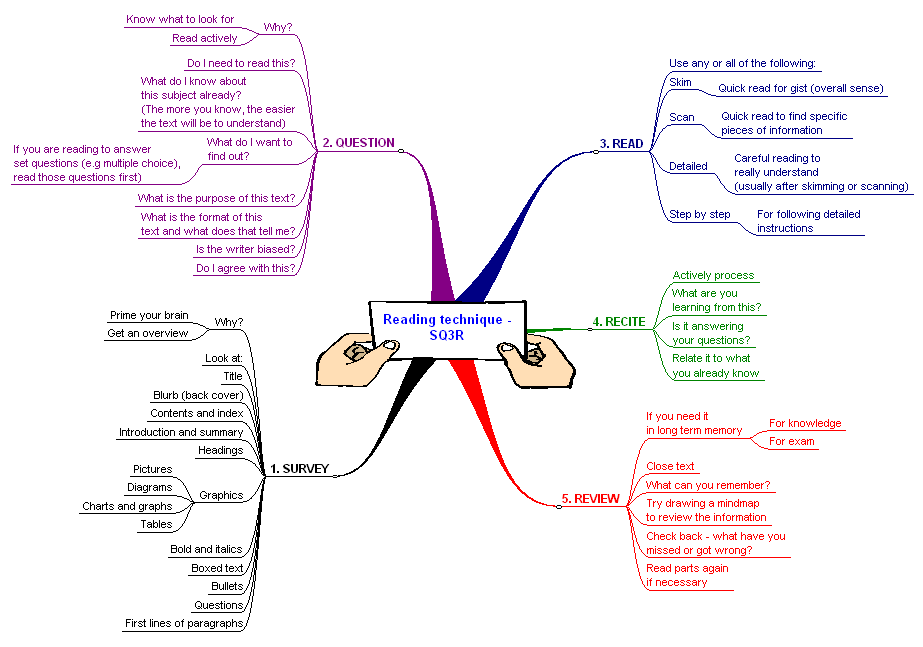
All groups, including repeaters, are writing their unit exam this week (Monday, Day 3 - Orange, Red, Purple and Tuesday, Day 4 - Blue).  Hopefully, you took advantage of an extra week and a four-day weekend. Perhaps some of you used the SQ3R (Survey, Question, Read, Recite, Review) method? See below.

Remember to keep the big picture in mind. Scan over your notes. Examine each time period. Who came to Quebec? Why did they come? From where? How did migration flows in any of the periods affect Quebec's society and territory? How did various groups of people change Quebec? Think about cause-effect. Think about Quebec's evolution or about continuity from 1500-2000. Make yourself a timeline of population & settlement, 1500-2000. Place migration flows and their effects on the timeline so that you can see things chronologically... Don't re-read the textbook. Examine (in your text and in your notes) graphs, charts, timelines, maps.

The exam consist of two parts:
Part 1: Three sections with 20 short answer questions based on documents. It is out of 37 marks. The questions cover all four periods: Aboriginal, French, British and Canadian. Half of your studying should be spent on the Canadian period. 10/20 questions cover this period (1867-2010); your essay is also about the Canadian period (part II). The ten other short questions are divided equally in number between the Abor, Fr., and British periods. Two of them cover all the periods (chronological order, for example).

Part II: A 250-word essay about demographic changes in Quebec over the course of the 20th century (1900-1999. It is also based on documents. It is out of 12 marks.


Survey: Get an overall picture of what you're going to study BEFORE you study. It's like looking at a road map before going on a trip. If you don't know the territory, studying a map is the best way to begin.

Question: Ask questions for learning. The important things to learn are usually answers to questions. Questions should lead to emphasis on the what, why, how, when, who and where of study content. Ask yourself questions as you read or study. As you answer them, you will help to make sense of the material and remember it more easily because the process will make an impression on you. Those things that make impressions are more meaningful, and therefore more easily remembered. 

Read: Reading is NOT running your eyes over a page of notes or a textbook. When you read, read actively. Read to answer questions you have asked yourself. Pay special attention to bold or italicized print. This material should receive special emphasis. When you read, be sure to read everything, including tables, graphs and illustrations. Often tables, graphs and illustrations can convey an idea more powerfully than written text.

Recite: When you recite, you stop reading periodically to recall what you have read. Try to recall main headings, important ideas of concepts presented in bold or italicized type, and what graphs, charts or illustrations indicate. Try to develop an overall concept of what you have read. Put it into your own words and thoughts. Try to connect things you have just read to things you already know. When you do this periodically, the chances are you will remember much more and be able to recall material for papers, essays and tests.

Review: A review is a survey of what you have covered. Rereading is an important part of the review process. Reread with the idea that you are measuring what you have gained from the process. During review, it's a good time to go over notes you have taken to help clarify points you may have missed or don't understand. The best time to review is when you have just finished studying something. Don't wait until just before an examination to begin the review process. Before an examination, do a final review. If you manage your time, the final review can be thought of as a "fine-tuning" of your knowledge of the material. Thousands of high school and college students have followed the SQ3R steps to achieve higher grades with less stress.

Ali & Takeshi: You might find this article interesting...  And this one. You know why.

Here's a visual of SQ3R:

Sunday, November 17, 2013

Short week: Nov. 17-19

Term II:
Time for some reassessment? What can you do or what can you change that will help you to: (a) better understand the material; (b) increase your success?

We are finished (almost) the contemporary Canadian period of the "population & settlement" unit. A final unit exam was scheduled for this week, but given a shortened week, that would be both unfair and impossible.

The unit exam (20 short answer, 1 essay) will be next week for all groups (Monday, Day 3 and Tuesday, Day 4). The exam covers all four periods: Aboriginal, French, British and Canadian.

In class:
Read p. 81-90 (complete booklet pages 3 & 4)
Correct booklet (post-war boom, 1930-1980)
Review activities
Study methods (SQ3R)
Review of the essay

Last page of notes in this section:


Next week we begin examining the economic development of Quebec over 500 years. Attachez-vos tuques, mes ami(e)s.

Wednesday, November 6, 2013

Nov. 4-8: Contemporary Canada, continued

This week in class:
- notes, 1867-1930;
- handout - reading with 7 questions;
- 1/2 hour to work on essay;
- textbook, p. 61-80.

A pop-quiz might be in your future...

Term essay (20%):
This week, you are handing in an essay about the changes that occurred in Quebec society between 1850 and 1900. Using the ten documents provided to you, your essay must focus on how "migration flows" affected the (1) ethnic composition, (2) the rural-urban distribution, and (3) the size of settled territory of Quebec. The important aspect of this essay is to show CHANGE; thus, you must indicate what existed in the 1850's, then discuss what the change was by 1900 and WHY the change occurred.

Essay writing:

1-Remember to start with an intro that answers the question. Keep it short, but make sure you include the three points you will discuss.
2- Make sure each paragraph starts with a topic sentence. It should sound something like this: "Over the course of fifty years, migration flows transformed the ethnic composition of Quebec..."
3-You must include a conclusion which recalls the topic and summarises the three main points of the essay. These two marks are critical!

Sunday, October 27, 2013

Oct. 28-Nov. 1: Canada, part 1 - 1867-1930 + Essay

Tests:
Monday, period 2 (01-Orange); Tuesday, period 4 (02-Blue): Test (Abor, Fr., Brit... see Oct. 21 post).

Contemporary Canada: Confederation to the Great Depression
textbook, p. 61-80
- the first 60 years of the Contemporary Canadian period (1867-1930)
- timeline of events that affect population and territory in Canada
- document analysis (emigration, immigration, urbanisation...) - handouts & textbook pages

Essay:
- short essay, based on documents
- how migration affected Quebec & Canada
- will be handed out next class (Thursday & Friday)
- due next week...

Monday, October 21, 2013

Oct. 21-24: Evaluation

This week, we are finishing the second part of population and settlement during British rule (1815-1867). Be sure to read over the notes on the period as well as the corresponding pages in your textbook, pp. 51-60.

Your test is either Wed. or Thurs. this week and consists of:

- 8 short answers based on documents (MELS-type) (17 marks... including two 3-mark causal questions!)
- 7 multiple choice questions (13 marks)
= /30 marks

- the evaluation covers content about the development of population and its impact on Quebec's society and territory; this includes the period of:

-the Aboriginals (origins, three linguistic groups, their ways of life, and characteristics of each);

-New France (problems of population growth, changes after Royal Government, measures taken by the government, results of government measures);

-British rule (continuity and change after the change of empire in 1760, changes in population owing to "migration flows," the changing map of Quebec from NF to the Constitutional Act, the impact of migration from the British Isles and French-Canadian emigration).


Monday, October 14, 2013

Oct. 15-18: British Rule, part II (1815-1867)

This week:
- review British rule, part I (correct homework, correct review sheet... FIB, T-or-F, timeline and 4 maps);
- analyse documents pertaining to British rule, part II

TEST:
- next week
- everything, thus far: ABOR-NF-BRIT
- short answer, based on document analysis

Monday, October 7, 2013

Oct. 7-11: British rule, part 1 (1760-1815)

This week we start the period of British rule! I know! Exciting...  

This week, we will examine changes and continuity to the population of Quebec, after the Conquest (1760). In terms of the population, little changed at first, despite the  new rulers. There was one notable change: no further immigration from France. From that point on, immigrants to Quebec were, for the most part, from the Thirteen colonies or from England.

First 50 years of British rule: 1763-1815:

British control of New France officially began in 1763, with the signing of the Treaty of Paris. New British laws were introduced to the colony with the Royal Proclamation (SIGNED 250 YEARS AGO, TODAY) and the boundaries of Quebec were reduced considerably. The first British governor of "Quebec," James Murray, was faced with a difficult situation; he was expected to implement laws and policies that would ultimately assimilate an overwhelmingly French-canadien society. 99% of the population was French-Catholic; 75% were farmers in rural areas. They had very few dealings with any English types.

Very few English migrants arrived in Quebec; by 1766, they numbered about 500. The English merchants who arrived in  Quebec were interested in controlling the economy, especially the fur trade. This small minority also wanted to pass laws that were beneficial to them. Governor Murray, however, was sympathetic to the canadiens farmers and seigneurs, even to the Catholic church. He found himself in direct opposition to the English merchants, owing to his conciliatory attitude toward the French majority.

In 1775, EVERYTHING changed. The "American War of Independence" began in the Thirteen Colonies. It had a major impact on Quebec's territory (before and after American independence), as well as on its society. Prior to the revolution, the British government expanded Quebec's boundaries (Quebec Act, 1774) to include the Ohio Valley. This enraged the governments and citizens of the Thirteen Colonies. During the American revolution, not everyone fought for independence; there were many who wanted continued ties with the British. Many of them suffered terrible things in America because of their support for the British King. These people came to be known as the "Loyalists." Thousands of them left the American colonies seeking safety; approximately 6000 migrated to Quebec in the late 1770's-early-1780's because Quebec was under British rule. With the creation of the United States of America, in 1783, Quebec lost the territory south of the Great Lakes that it had gained in the Quebec Act.

The Loyalist arrival had a tremendous social effect on Quebec; it was the true beginning of dualism in Quebec. By 1784, the English-speaking population made up 15% of Quebec's population. The Loyalists who arrived in Quebec expected to find British institutions: laws, Protestant churches, out-right ownership of land, as well as the right to vote. They were sorely disappointed. Instead they found French-language institutions which were unfamiliar to them - and a system of government that was not democratic. The Loyalists petitioned the British government for changes. The British solved the problem first by settling the Loyalists in the western part of Quebec (now the Great Lakes region) and then dividing Quebec into two separate colonies, Lower and Upper Canada (see map below). This was enacted in the Constitutional Act, of 1791.